After Achilles
Joyce, Bloom, and the Making of the Everyman Hero

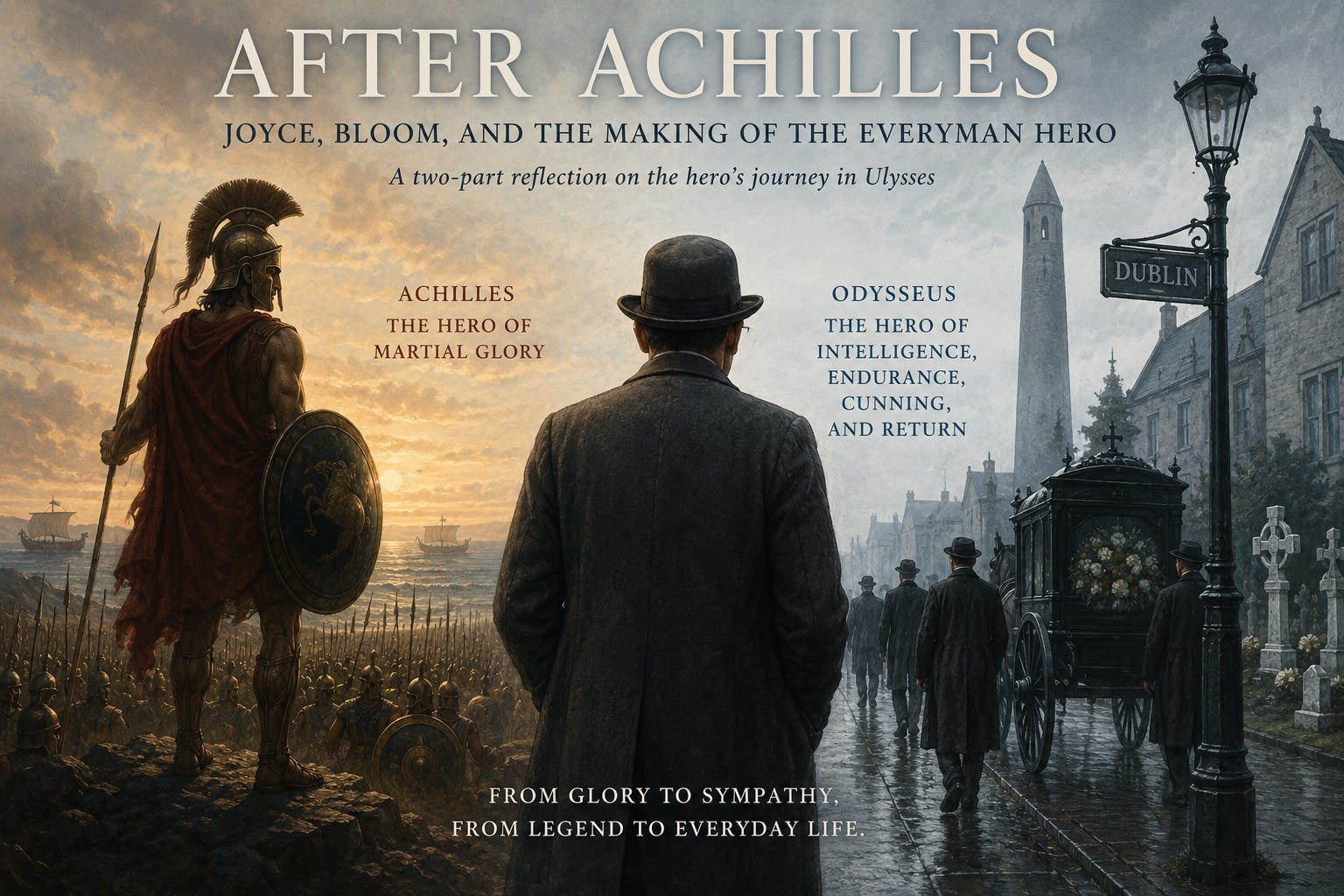
Executive Summary
This essay is the first of a two-part reflection on Joyce’s use of the hero’s journey in Ulysses. Part One follows the novel through Episode 6, “Hades,” as this is where the slow-read seminar I am co-leading has reached. I will publish Part Two after we complete the book. At that time, I plan to return to the questions of transformation, homecoming, and whether Leopold Bloom is ultimately a modern hero or something else.
The heroic journey is one of the West’s most enduring narrative patterns. It usually involves a young man (though it could be a woman) leaving home and then encountering and overcoming significant trials. It often entails the hero confronting death (either physical or spiritual). And it resolves with the hero returning changed/transformed. In The Odyssey, Odysseus is the primary embodiment of this journey. At the same time, we have another protagonist, Achilles, who epitomizes what a Greek hero should be in The Iliad and what his post-death realization is in The Odyssey. Joyce ingests this structure in Ulysses and begins to remake it through Bloom.
By the end of “Hades,” the transformation is already visible. In The Odyssey, Odysseus is directed by Circe to venture to the underworld to find the way home. By contrast, in Ulysses, Bloom enters a Dublin cemetery and receives neither a prophecy nor insight from the dead. Instead, he reflects on the rituals of death and funerals. He also spends time meditating on the fact that death is one of the few shared human experiences.
This difference, and what Joyce is up to, is the focus of this essay. I don’t think Joyce is mocking the heroic journey. Instead, he begins to humanize it. By Episode 6 in Ulysses, we see that Joyce is evolving the meaning of heroism away from what the Greeks valued (glory, conquest, and legacy) toward a new set of values and virtues (e.g., attention, sympathy, and the capacity to remain fully human). Joyce suggests that the modern hero may not be the man who rises above ordinary life, but more like an Everyman who moves through life without surrendering his humanity.
Part One: From Glory to Sympathy
As a young man, I yearned to be a hero in something like the Greek sense. I went to the Naval Academy when the Cold War was still very real. If you had asked me then why I chose that path, I would have spoken about duty, country, leadership, and service. All of that was true, but beneath this lofty aspiration was also a longing to test myself. I wanted to fly planes. I wanted to be on the front lines if war broke out with the Russians. I wanted to leave behind some evidence that I had done my part, even if that meant, paraphrasing Neil Young, “burning out” rather than “fading away.” Yes, I was young and naive.
But this longing was not just naive ambition. It was rooted in one of the foundational narratives of the Western imagination: the hero’s journey. Joseph Campbell named this narrative structure in his seminal work The Hero with a Thousand Faces. He was describing a structure that had already shaped many of the stories and culture experience I (and my generation) grew up with. Most action films (e.g., the Marvel films, James Bond), war stories (e.g., Hacksaw ridge), fantasy epics (e.g., Lord of the Rings), and coming-of-age novels (e.g., All the Pretty Horse) that I voraciously consumed all draw from some version of it. For example, George Lucas has been explicit about Campbell’s influence on Star Wars. Frank Herbert’s Dune, written before Campbell’s book, reveals the darker possibilities of the same heroic arc. The appeal of this narrative structure is enduring because the pattern rests on two deeply human premises:
We all face ordeals
We find meaning in life partly through how we meet, respond, and are defined/changed by these ordeals
That is one of the most interesting Homeric transformations Joyce undertakes in Ulysses, and it points to a central question for the novel: what happens when one of the oldest heroic patterns in Western literature is set within the ordinary movements of a single Dublin morning?
The Heroic Ideal We Inherit
For Homer, the hero stands apart. He usually is exceptional in some way. For example, he could have unusual strength, courage, cunning, endurance, or force of will. He is clear that the way to win honor is through action (usually in battle) and that his legacy will be determined by how he conducts himself. But, at the end of the day, his life matters because it is not ordinary: he is extraordinary.
Achilles is the purest embodiment of that ideal. In The Iliad, he has the opportunity to choose his path: He can either live a long, obscure life or die young and win glory forever. He chooses glory because Achilles is the hero who will not settle for an ordinary life. He wants greatness, and he is willing to pay for it with his life. This aspiration has been enormously important for generations and explains why Achilles has remained so compelling for nearly three thousand years. The young are often drawn to him because he lives intensely. He doesn’t want to be a baker, marry a nice girl, and crank out some kids. He wants his life to matter on the largest possible scale.
And this is the appeal.
I recognized some version of that aspiration in myself. I wanted to serve, but I also wanted my service to matter. I wanted to believe that if I demonstrated courage, was willing to sacrifice, and seek excellence, I would live a life worth living. I.e., there would be some external validation. The heroic journey narrative shows the way. It encourages us to leave home, face the world, and confront death so that we can return with a deeper sense of our identity. At the same time, it helps to make suffering more meaningful. We want to know whether difficulty can transform us. We want to know whether life can be more than just making it through.
Odysseus and the Heroic Journey of Return
One of the best parts of reading The Odyssey right after The Iliad is seeing how Homer evolves and expands the heroic ideal. Achilles represents one form of Greek greatness: glory won through courage, force, and the willingness to risk everything for honor. Odysseus represents another set of qualities: intelligence, endurance, cunning, and the capacity to survive and return home. The Greeks value both. Achilles is the hero of war. Odysseus is the hero of resourceful endurance.
Odysseus is not merely trying to survive the aftermath of Troy. He is trying to come home, defined broadly. I.e., he is not just returning to Ithaka. His return also includes him reestablishing his identity after being gone for 20 years. Before he left, he was a husband to Penelope, a father to Telemachus, and a son to Laertes. He was also the king of Ithaca and clearly the master of his household. In essence, he was a “known” man for all the right reasons.
That is what makes The Odyssey such a profound account of heroism. Sometimes the greatest danger is not death, but losing an understanding of who you are and the desire to return. Again and again, Odysseus encounters temptations that could prevent him from returning home. The Lotus-Eaters offer forgetfulness. Circe offers pleasure and delay. Calypso offers immortality. The Sirens offer knowledge severed from obligation. Each temptation asks, in a different form, whether home is still worth wanting. Odysseus’ heroism lies in his continued desire to return home and reestablish his identity. He does not simply endure danger. He remembers who he is by remembering where he belongs, and that makes the journey and travails worth it.
That is why the descent to Hades in Book 11 of The Odyssey matters so much. The hero can’t return home; he first moves through death. Odysseus has crossed seas, survived monsters, and endured Poseidon’s wrath. But he still lacks the knowledge required to return fully, not just the directions to sail to Ithaka. Circe tells him that he must go to the land of the dead and consult Tiresias, the blind prophet.
What the Dead Teach Odysseus
Odysseus’ visit to Hades is not merely an eerie interlude. It is an essential moment in The Odyssey and stands as one of the most important lessons for Homer’s audience throughout the ages. Before the dead can speak, Odysseus must perform the proper rites. He digs a trench, pours libations, sacrifices animals, and holds the shades back until Tiresias arrives. The underworld may be terrifying, but it is not meaningless. It has order, and there is a right way to conduct the ritual.
Tiresias then tells Odysseus what lies ahead. Poseidon remains angry. The island of the Sun will become a decisive test. If Odysseus’ crew leaves the cattle of Helios untouched, they will survive. If they kill the cattle, destruction will follow. Tiresias tells him that he will eventually reach Ithaca alone, on another man’s ship, and that he will find suitors consuming his house and courting his wife. He tells Odysseus that he must defeat them. He even tells him that after the restoration of his household, another journey remains: he must carry an oar inland until he reaches people who do not know the sea. For a world where everyone seeks oracles for guidance, this guidance is particularly specific. The future is knowable. Odysseus cannot control it, but he can be told its outline. Fate does not remove agency; however, this insight gives Odysseus guidance (similar to Achilles’ knowing his fate).
His mother, Anticleia, gives him another kind of knowledge. Odysseus did not know she had died. Seeing her among the dead is one of the episode’s great shocks. From her, he learns what has happened in Ithaca during his absence. Penelope remains faithful and sorrowful. Telemachus lives, but Laertes has withdrawn into grief. His mother herself has died not by disease or violence, but from longing for him. Talk about mother guilt!! (side note: Stephen D in Ulysses has some of this going on big time). This changes the meaning of return. Odysseus’ absence has not merely endangered his estate. It has wounded those who love him. Home is not sitting untouched, waiting for his arrival. Home has suffered because he has been gone.
Then come Achilles and Agamemnon, each offering a different correction to the heroic imagination. Odysseus praises Achilles as fortunate, honored in life, and powerful among the dead. Achilles rejects the consolation. He would rather be a hired laborer among the living than king over all the dead. The greatest hero of The Iliad now tells us that glory does not transcend death. HEAVY!
That moment does not erase Achilles’ heroism, but it complicates it. The man who chose fame over life now speaks from the far side of death and tells Odysseus that life itself is more precious than heroic memory. Odysseus, who has always wanted to get home alive, receives confirmation that his desire is not merely cautious. It is deeply human.
Agamemnon offers a darker lesson. He survived Troy only to be murdered at home by Clytemnestra and Aegisthus. His story warns Odysseus that the very act of returning can be dangerous. A man does not simply arrive home and resume his place. He must assess the house he is re-entering. He must conceal himself, test loyalties, and recognize that intimacy can be treacherous.
And this sets up the rest of the story. So Hades gives Odysseus more than prophecy. It gives him a moral map of return. He learns what is happening at home, what death reveals about heroic glory, and why homecoming must be approached with caution. The dead teach him how to live.
Joyce Brings Bloom to Hades
Joyce gives Bloom his own Hades in Episode 6 of Ulysses, but the experience is radically altered. Bloom does not cross the River Ocean. He rides through Dublin in a funeral carriage that crosses over the Grand Canal. He does not descend into a shadowy realm populated by legendary dead. He attends the burial of Paddy Dignam at Glasnevin Cemetery. There is no Tiresias waiting. His dead mother does not step forward to speak. Bloom receives no map for the future. He gets no prophecy about Molly, Boylan, or the course of his own day.
Yet, Joyce clearly wants us to see the parallel. Bloom has left home. At this point in the novel, he has passed through appetite, concealment, religious ritual, and private desire—the trials of everyday life. Now he enters the realm of death. Joyce is still using the hero’s journey arc, but the terms have changed. If Odysseus’ Hades is a place where death speaks and provides insight, then Bloom’s Hades is a place where death provokes thought.
In the previous episode, “Lotus Eaters,” Bloom enters a Catholic church and watches the Mass. He is curious and receptive to the beauty of ritual. But he also experiences it from the outside. He recognizes that the ritual depends upon genuine belief, saying, “Thing is if you really believe in it.” He has the same sense for the ritual of the funeral. Bloom hears the language of salvation and what it means to have a soul, but he does not really process it. What I find especially interesting in this episode is that his thoughts and imagination do not ponder heaven or eternal reward. Instead, he ponders coffins, corpses, worms, decay, burial practices, premature burial, cremation, widows, children, and the practical realities after someone dies. Contrast this with Stephen Dedalus’ musings in Episode 3 on Aristotle, Aquinas, etc.
This is important. Bloom is not simply irreligious. He is an outsider moving through a religious culture whose symbols he can recognize but not fully possess. He sees the consolation ritual offers. The funeral does not disclose the meaning of death to him. It gives him occasions to think about death from multiple angles: physical, social, domestic, and emotional. In Homer, the dead explain themselves. In Joyce, the living must ponder what death means in the presence of the dead.
From Heroic Death to Ordinary Mortality
There is another important difference in the representation of the underworld. Homer’s underworld contains many souls, but the episode focuses on extraordinary figures (e.g., Tiresias, Anticleia, Achilles, Agamemnon, and Ajax) who offer insight and advice. Death becomes an opportunity for Odysseus to deepen his understanding of the ideas of honor, fame, household, and betrayal. Most importantly, he confronts the limits of heroic achievement through his conversation with Achilles, and, I think, this is the key moment of his transformation. “Dead” Achilles would trade all of his honor and glory to be alive again, even if it meant he was only an ordinary day laborer. After this conversation, Odysseus recognizes the value of being able to return home and “fade away” versus “burn out.”
By contrast, Joyce democratizes the underworld. Paddy Dignam is not Achilles. He is not a king, warrior, prophet, or founder. He is an ordinary man from Dublin. He leaves behind a widow, children, debts, and acquaintances. As Joyce makes clear through the other characters, even though many people knew Dignam, their memories are already beginning to blur or become confused by the time of his funeral. His funeral is meaningful, but it is really just one death among many. In fact, there are two more funerals teed up for the next day.
Bloom’s inner monologue shows that he sees the cemetery as a landscape crowded with ordinary people. All these people, once alive, are now buried in the same place regardless of title or social status. The question is not only what Dignam’s life meant. It is what any life means once the person is gone and the world keeps moving.
This gives Bloom a kind of moral sensitivity that is very different from Homeric heroism. He is not measuring the dead by the lives they lived or by whether they had glory or fame (i.e., external validation of honor or glory). While the other men in the carriage participate in the funeral as a public ritual by talking, recalling, speculating, joking, and observing the social conventions of mourning, Bloom goes beyond the surface. He thinks about the widow and children. He thinks about the body in the grave. He thinks about the awkwardness of resurrection when bodies have decayed. This is not heroic in the Homeric sense. But Joyce seems to ask whether it might be heroic in a modern one.
The Everyman Hero, So Far
By Episode 6, Joyce has not yet completed Bloom’s journey. We do not yet know whether Bloom makes it home, and if he does, whether he is transformed. This is what I will explore in Part 2. But, at this point, we can already see that Joyce is remaking the old heroic pattern.
Odysseus leaves home and enters a world of mythic danger <>Bloom leaves home and enters a world of estrangement.
Odysseus descends to Hades to receive knowledge from the dead<>Bloom enters the cemetery and receives no revelation. He only becomes more aware of death’s presence in common life.
Odysseus learns how to navigate fate<> Bloom moves through a world where fate no longer seems to be at play.
The evolution challenges our expectations of a hero. The Homeric hero is, by definition, exceptional. He is stronger, more cunning, more enduring, more favored or harried by the gods than other men. He stands apart.
By contrast, Bloom is remarkable precisely because he does not stand apart in that way. He is ordinary, vulnerable, socially awkward, physically embodied, and only partially at home in the world through which he moves. At the same time, Bloom notices things others don’t. He is able to sympathize/empathize with others. Finally, he refuses, at least so far, to harden himself against the awkwardness and sorrow of other human beings, even when he, himself, is being discriminated against.
Through “Hades,” Bloom has not become a hero in any final sense. Joyce has not yet told us what his journey will mean. But he has already begun to ask whether the Everyman who moves through death, ritual, uncertainty, and the uncelebrated losses of ordinary people with his humanity intact may deserve a place beside the older heroes after all.